
Drainage and Water Flow: Reading the Site Before You Build
Field Notes by Stephen Coan
Before a single plant goes in the ground, water decides what will thrive. Drainage and water flow are the hidden architecture of the landscape, shaping soil health, plant performance, and long-term durability. This note explains how I read grade and runoff, why “fixing drainage later” rarely works, and how quiet water solutions can disappear into the design while protecting the garden for decades.
Drainage, Grade, and the Quiet Logic of Water
At Stephen Coan Garden Design, water is treated as both an ecological force and a design element. The goal is never to “engineer” the garden. The goal is to make the landscape behave intelligently, so planting can establish cleanly and the finished work reads as calm, refined, and inevitable.
In the Philadelphia tri-state (NJ/PA/DE), drainage problems are rarely mysterious. They are predictable outcomes of grade, soil structure, roof runoff, and where water is allowed to concentrate. When these forces are read early, the solutions can be simple, quiet, and integrated.
Why drainage is design, not a repair
Most landscape failures that homeowners call “plant problems” are actually water problems:
-
plants that never establish because roots sit in saturated soil
-
beds that wash out after storms
-
paths that heave, settle, or stay muddy
-
low spots that become mud season traps in spring and ice patches in winter
When drainage is treated as an afterthought, you pay twice. Once for the installation, and again to undo what water inevitably reveals. When drainage is treated as design, the garden matures faster, performs more consistently, and stays easier to care for.
What I look for when I read the site
Reading water is not one observation. It is a pattern. On a site visit, I’m paying attention to:
-
Grade and low points: where water naturally wants to pause or pool
-
Roof runoff: downspouts, splash zones, and where that water actually goes
-
Hardscape edges: patios, walks, and driveways, and how they shed water
-
Soil behavior: how quickly it absorbs, how long it holds moisture, and how it compacts
-
Existing clues: erosion channels, sediment fans, moss lines, and stressed plant zones
-
Seasonal reality: freeze-thaw movement, spring saturation, summer drought stress
This is why the on-site consultation matters. Water patterns can’t be guessed from a photo. They’re read on the ground.
The three questions that guide every water decision
Every drainage plan I design answers three questions:
-
Where is the water coming from?
Roof runoff, slope, neighboring properties, hardscape, a clay layer, or a compacted lawn that sheds instead of absorbing. -
Where does it concentrate?
A low point, a foundation edge, a walkway joint, a downspout discharge, a driveway seam, or the spot that always stays soft. -
Where should it go instead?
Into a planted infiltration zone, a basin designed to hold and release slowly, a rain garden, or a clear overflow route that moves water safely.
A good solution is not just “get it away.” It manages volume, speed, and destination with intention.
Quiet solutions that disappear into the design
In a plant-forward landscape, drainage should not read as a patch. It should feel like part of the composition. Depending on the site, water management may include:
-
Subtle regrading to re-establish proper flow without obvious reshaping
-
Shallow basins and infiltration zones planted to look like garden, not infrastructure
-
Rain gardens designed as seasonal planting, not a utilitarian pit
-
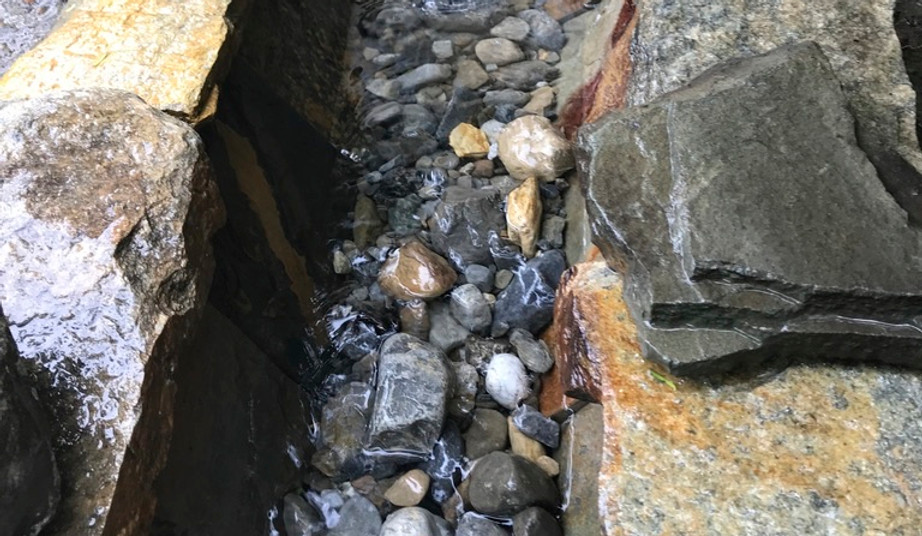
Stone channels or gravel runs that read as quiet hardscape detail
-
Permeability upgrades where appropriate: gravel, permeable paving, or planted absorbers
-
Downspout capture and redirection integrated into beds with clear logic
The goal is always the same: protect the home, protect the soil, and let planting thrive without constant triage.
What drainage changes for planting
Once water behavior is clarified, everything gets easier:
-
plant selection becomes more accurate
-
roots establish faster
-
disease pressure drops in beds that were staying too wet
-
drought stress is reduced in areas that were shedding water too quickly
-
the garden becomes more predictable across seasons
This is also where a refined landscape starts to show its difference. The planting looks effortless because the site conditions are no longer fighting it.
Why “more topsoil” and “more mulch” rarely fix water
Two common mistakes I see:
-
Raising a bed without addressing the source of water. The bed looks taller, but the problem simply moves to the next low point.
-
Using mulch as a dam. Mulch can trap moisture where plants do not want it and create a soft, unstable surface that breaks down into compaction.
Sometimes the solution is not “add.” Sometimes it is “shape.” Grade is the quiet lever that makes everything else work.
South Jersey and the tri-state: different soils, different failure modes
Parts of South Jersey have sandy soils that drain quickly, which can push summer drought stress sooner than clients expect. Other areas across NJ/PA/DE deal with heavier soils, compaction, and slower infiltration that hold water too long.
In both cases, the answer is not a one-size product. It is reading the site and designing the correct relationship between soil, planting, and water movement.
In Practice
A simple rule before you build
If you can’t clearly describe where water comes from, where it concentrates, and where it safely goes, don’t start construction. Read it first, shape it second, then build planting and hardscape on top of a stable foundation.
The bottom line
You don’t need a landscape that looks engineered. You need a landscape that behaves intelligently.
When drainage and water flow are solved quietly, the garden becomes easier to live with: plants establish faster, hardscape lasts longer, and the entire property reads as calm and intentional in every season.
Begin the Conversation
Begin with a brief phone conversation to explore your goals and property. When we’re aligned, an on-site consultation is scheduled and the most appropriate path forward is defined.